Brewing in SE London
Brief History of Brewing in SE London
London has a long history of brewing, stretching back to Roman times, and by the Middle Ages there were thousands of small households and alehouses brewing unhopped 'ale'. By the 14th century, London's brewers had come together to form the Worshipful Company of Brewers (now more commonly known as the Brewers' Company).
In the 15th century 'ale' began to become 'beer' as we know it today with the arrival of hops from continental Europe.
In the 18th century, London's beer production expanded on a global, industrialised scale. Its brewers invented a dark, well-hopped, roasted beer that became known as porter, after the market and river porters who favoured the new drink to give them sustenance. London then became the world's largest brewing location.
Read a more detailed history of porter in a blog by the Anspach & Hobday brewery here.
The local brewing industry continued to expand during the Victorian period (19th century) with Bermondsey and Southwark being favoured locations, having a good water supply, river access for shipping, and plentiful cheap railway arch storage.
Anchor Brewery
Having been built in the early 17th century close to the site of Shakespeare's original Globe Theatre, the Anchor Brewery on Park Street, Bankside was acquired by brewers Barclay Perkins & Co in 1787. Over the next two decades this brewery grew to become the largest in the world.
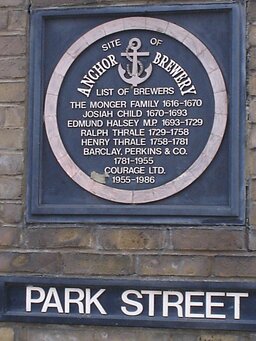
Barclay Perkins merged with rival London brewer Courage in 1955 and the Park St site became a bottling and packing plant until operations there ceased in the early 1970s. The buildings were then demolished in the 1980s. A plaque now commemorates the site of the brewery.
The former brewery tap, the Anchor, still exists.
Anchor Brewhouse
Not to be confused with the above brewery, the Anchor Brewhouse was initially a small brewery situated by Shad Thames in what was then the small parish of Horsleydown.
The leasehold was purchased in 1787 by Courage brewery who later rebuilt the premises after a fire in 1891. Subsequently, in 1925, the company acquired the freehold of the site and undertook a significant rebuilding and expansion of the brewery.
Following the merger with Barclay Perkins in 1955, the combined brewing company was renamed Courage Barclay & Co, with brewing activity consolidated at the Anchor Brewhouse.
However, in the late 1970s Courage began to transfer its brewing activities out of London and the Horsleydown site finally closed in 1981.
A number of the former brewery buildings remain and in the late 1980s were converted into the Butler's Wharf residential development.
The former brewery tap, the Anchor Tap, also still exists.
Lion Brewery
The Lion Brewery was built in 1836 adjacent to Hungerford Bridge on what is now known as the South Bank.
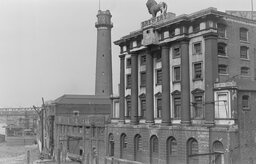 Lion Brewery Image credit: London Museum
The brewery shipped beer around the then British Empire and, in common with other breweries, needed to increase the strength of the beer and quality of hops to enable the brews to survive sea voyages of up to six months. This style of beer became known as India Pale Ale.
In 1924 the brewery was acquired by Hoare & Co but the main building was badly damaged by fire in 1931 and brewing never recommenced there. Having then largely remained vacant, the premises were demolished in the late 1940s as part of the site clearance for the construction of the Royal Festival Hall.
The stone lion that adorned the roof of the brewery was, however, rescued and now sits at the southern end of Westminster Bridge.
Decline of Brewing in London
From the 1950's onwards, with many smaller brewers struggling post-WWII, there were a series of mergers and acquisitions undertaken by the larger brewers. In many cases brewing operations were also moved to cheaper locations outside of London, particularly where valuable inner-London sites could be sold for alternative uses.
By the end of the 1980s the UK beer market was dominated by just six large, national brewers who also owned large portfolios of tied public houses:
- Allied Breweries - incorporating Ansells (B'ham); Ind Coope (Burton); Tetley Walker (Leeds);
- Bass - incorporating Charrington (E London); Mitchells & Butlers (W Midlands); Wm Stones (Sheffield);
- Courage - incorporating Barclay Perkins (SE London); H&G Simonds (Reading); John Smiths (Tadcaster);
- Grand Metropolitan - incorporating Truman's (E London); Watney Mann (London);
- Scottish & Newcastle - incorporating Wm Younger; McEwans; Newcastle Breweries;
- Whitbread - incorporating over a dozen regional breweries acquired (and often then closed) in the 1950s and 1960s.
In response to concerns over a lack of competition and consumer choice, the UK government enacted the 1989 Beer Orders which restricted the number of pubs large breweries could own to a maximum of 2,000.
This resulted in the major breweries spinning off large pub portfolios into pure pub-owning entities ("pubcos").
The Beer Orders were revoked in 2003.
Rise Again of Brewing in SE London
The early 21st century saw a resurgence in the number micro-breweries establishing in SE London, many of which also operated an onsite brewery taproom.
A particular concentration developed along what became known as the Bermondsey Beer Mile, with the breweries mainly located in, what were then relatively cheap to rent, railway arches.
Kernel was the first such brewery to establish in the area in 2009.
They were soon followed by the likes of Partizan (2012), Fourpure (2013), Anspach & Hobday (2014), and Southwark Brewing (2014).
Over the subsequent years, the venues along the Beer Mile have become more mixed as some breweries have closed or relocated, and new non-brewery bottle shops and bars have opened.
Having started in Bermondsey, the growth in micro-breweries then spread further around our branch area but often located in railway arches.
Unfortunately, in the years following the 2020-21 COVID pandemic, a number of small breweries have struggled with some failing and others being rescued and acquired by other breweries or equity groups.
Small breweries also continue to face challenges with being able to get their beers into pubco tied venues.
There do, however, continue to be a healthy number and variety of small breweries in our branch - though unfortunately they don't all produce cask beer!
You can search the national brewery database via the CAMRA national website.
Click here for a pre-populated brewery search centred on Lewisham which is roughly in the middle of our branch. Use the available filters if you wish to narrow the search further, such as by breweries producing cask beer and/or those with a taproom.